Levering Up Your Specialists With On-Demand Labor: What It Looks Like In Practice
See how businesses use Veryable’s on-demand labor model to reallocate surrounding work and get more output from the specialists they already have.

Hurricane season opened June 1st, and NOAA's 2026 outlook calls for a below-average year: 8 to 14 named storms, 3 to 6 becoming hurricanes. That sounds reassuring, but a mild forecast isn't a guarantee, it only takes one storm making landfall in the wrong place to turn into a very bad year for your operation (see 2023, when a "near-normal" forecast still produced 20 named storms). The real peak, mid-September through October, is still ahead.
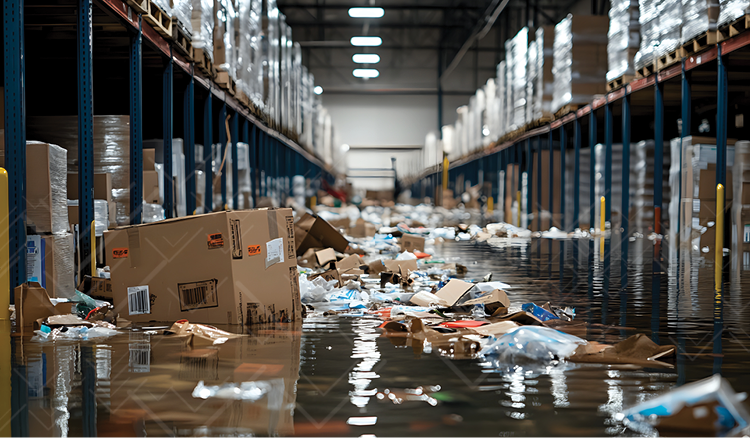
If you run a manufacturing plant, warehouse, or distribution center on the coast, you already know the scenario you can't plan away: the power goes out, the floors flood, half your team can't get to work, and orders keep piling up whether you're open or not.
You can't control the storm. But you can control how ready your operation is when one hits.
A hurricane doesn't hit your operation just once. There's the scramble to prepare before it lands, and the scramble to recover once it's gone, and a workforce that's 100% full-time struggles with both.
Before landfall, you need extra hands fast: securing inventory, boarding up, pushing through a final production run before the plant goes dark. A fixed team can't expand for that. You either pull people off their normal jobs, pay overtime you didn't budget for, or just don't get it all done before the storm arrives.
After the storm passes, the real crunch begins. Power comes back, but not everyone does. Employees are dealing with flooded homes, damaged cars, and family emergencies of their own, so your available headcount is smaller than normal right when you need more of it to clear a backlog, dig out from cleanup, and fulfill delayed orders. With an all-FTE workforce, your recovery speed is capped by however many of your own people can make it in. There's no lever to pull to go faster.
Temp staffing agencies look like that lever, but they're not, not in this situation. They rely on a fixed regional roster and still need lead time to place people, time you often don't have once you decide you need more hands before a storm. During recovery it's worse: every other facility in the region is calling the same handful of agency branches at the exact same moment, for the same reason. That roster doesn't scale to meet a regional spike, so what labor is left gets rationed and spread thin fast, and what you're offered is whoever's available that day, often people dealing with their own storm damage who show up out of obligation, not choice. That's exactly the moment good labor gets hardest to guarantee, and it's the moment agencies are worst positioned to deliver it.
Veryable is an on-demand labor marketplace built for manufacturing, warehousing, and logistics operations. Businesses use the platform to post short-term work opportunities, called Ops, for the specific tasks, shifts, and skills they need. Local operators (vetted independent workers) then bid on the Ops that fit their availability, and the business selects who to bring in based on experience, ratings, and past performance. No dispatcher assigning a random crew, just people who actually want the work.
After each Op, you rate the Operator who worked it. Rate someone four or five stars and they're saved into your labor pool, the group of proven Operators you can invite directly to future Ops instead of relying on the open market. Think of it as a flexible extension of your core workforce, headcount you can call on without carrying it on payroll: 10 extra people one day, 2 the next, none the day after that, sized to whatever that day actually needs.
Most operations need a short burst of extra hands for one list of urgent tasks: securing inventory, boarding up, or pushing through a final production run before the plant goes dark. Post an Op and get help for that day or two of work, instead of pulling your core team off their regular jobs or burning through overtime to cover it, and without waiting on an agency to scramble a crew together.
The portion of your labor that's flexible through Veryable scales down the moment you know you need to close. You're not locked into weekly agency minimums, so you simply don't post or accept Ops for the days your facility is dark, dropping that piece of your variable labor cost to zero instead of carrying a fixed expense through the closure.
This is where the model matters most: you need to move fast to clear backlog, get the facility back to full throughput, and catch up on orders, all while some of your own team is still dealing with the aftermath at home. That means bringing in extra hands for cleanup, sorting, and facility resetting so your trained team isn't pulled off the specialized work only they can do, and adding people on the dock so trucks get loaded and unloaded as soon as they arrive instead of sitting in a lot while highways and schedules catch up.
It's fair to ask whether local Operators are just as exposed to the same storm. They are. The difference is the bidding model: it acts as a natural filter. Because Operators have to actively choose to bid on an open shift, the bids you get tend to come from the subset of the workforce that still has power, working transportation, and the capacity to take on extra hours, many of them actively looking for that extra income to cover their own storm expenses. That's not a guarantee every bid shows up, but it beats calling a dispatcher and hoping enough names on a list pick up the phone. You're seeing people who chose the work, not a random name off someone else's list, which solves most of the reliability problem a traditional agency has in the same situation, and lets your own affected employees focus on their own recovery without you losing all your production capacity to cover for it.
A Houston based regional consumer products distributor lost power for the better part of a week when Hurricane Beryl came through in July 2024. Many of their full-time staff couldn't make it in, kept home by power outages, property damage, and transportation problems, and the facility and product took damage from flooding.
Because they already had a Labor Pool in place, they didn't have to figure this out on the fly. The week before the storm, they'd posted 341 hours of Ops. During the outage week, that dropped to 107 hours as they scaled down and avoided paying for labor they couldn't use. Over the next two weeks, it climbed to 545 and then 643 hours as they posted more Ops than normal to clear the backlog, getting the facility running ahead of schedule instead of limping back for weeks. Their customers didn't know or care that a hurricane caused the delay, they just wanted their product on time, and a flexible Labor Pool made that possible.
On-demand labor isn't something companies reach for only during a disaster. It's used day to day and week to week to match labor with actual demand:
That's the day-to-day and week-to-week reality behind the model, and it's what quietly builds the Labor Pool you'd lean on if a storm ever hit.
A new company can create a profile and post its first Op the same day, bypassing legacy agency contracts entirely, a speed no traditional staffing agency can match. If a hurricane's already bearing down and you've never used Veryable before, that speed is real, and it's exactly why we can still help when things are already moving fast.
But that capability is a safety net, not a substitute for a plan. Deploying fast during a crisis still means introducing Operators to your facility for the first time, under the worst possible conditions, with no familiarity with your layout, safety protocols, or equipment.
That's not a reason to skip Veryable in an emergency. It's the reason not to wait to start building a labor pool.
Use that same speed now, while there's no storm on the radar, and the equation flips. Get your profile live and post routine Ops for the gaps you already have, and within a few weeks you have a warm pool of Operators who know your facility, your layout, and how your team runs. Then when a storm hits you're activating a familiar, trusted network with the push of a button.
You can't control whether a storm hits your facility this year, but you can control whether you already have a Labor Pool in place when it does. Start today: post your next busy shift, seasonal push, or coverage gap as an Op, and you're already building the pool that has your back when the weather turns.
Looking for assistance? Check out our quick start guide or get in touch.



Create your free business profile and begin building your on-demand labor pool today.