How On-Demand Labor Solves the Night Shift Coverage Problem That Permanent Headcount Never Will
Night shift positions carry higher turnover than any other role in manufacturing. Learn why conventional approaches keep failing and what actually works.

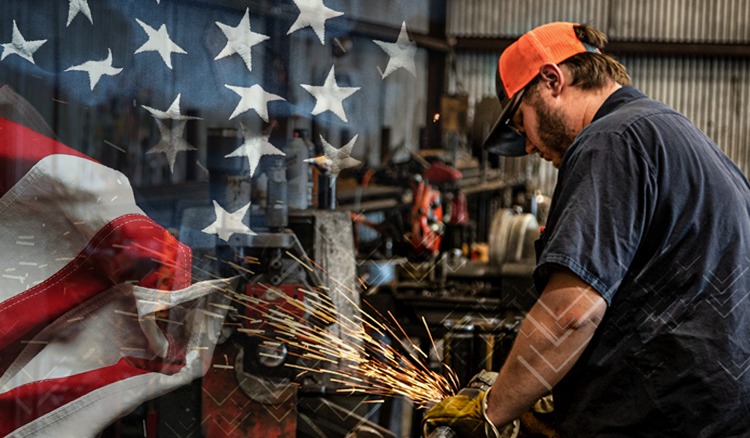
America's 250th anniversary will bring renewed attention to founding documents, historic battles, visionary leaders, and defining milestones. Those stories deserve to be told. They explain the ideals that gave this country its character and the choices that shaped its course.
But America was never built on ideals alone.
It was built in iron foundries, blast furnaces, and textile mills. In shipyards and workshops and small-town smithies. In the hands of workers who transformed raw materials into something the country could actually use: tools, weapons, infrastructure, machinery, goods. The kind of productive capacity that turns principles into power.
For nearly 250 years, American manufacturing has been the engine behind the nation's ability to provide for itself, defend itself, and stand apart from the rest of the world.
That is not a footnote to the American story. It is one of its defining chapters.
And it starts earlier than most people think.
To understand why manufacturing became America's lifeline, you have to understand why America had almost none of it at the start.
This was not an accident. It was policy.
The British Empire built its colonial system around extraction. The colonies supplied raw materials. Britain supplied finished goods. The colonists were customers, not competitors. Parliament intended to keep it that way.
The Iron Act of 1750 made that intention law. It prohibited American colonists from building new iron-processing mills and banned the manufacture of finished iron products in the colonies. Pig iron and bar iron could be exported to Britain. But the value-added work, the forging, the casting, the toolmaking, would be done in British factories. Americans would buy back the finished products at British prices.
The logic was clear: keep the colonies dependent, and you keep them controlled.
It worked. By the time the first shots were fired at Lexington and Concord in 1775, the American colonies had almost no industrial base capable of equipping an army. No powder mills of consequence. No cannon foundries. No organized supply chain for weapons, uniforms, or equipment. Thirteen colonies full of farmers and tradespeople, facing the most powerful military empire on earth, with virtually no capacity to manufacture the materials of war.
What followed nearly ended the revolution before it found its footing.
The Battle of Bunker Hill in June 1775 is remembered as an early symbol of colonial defiance. It should also be remembered as a supply chain catastrophe.
The Patriots held the high ground. They inflicted serious casualties on British regulars advancing uphill. They were winning. Then they ran out of ammunition.
The British took the hill. The Continental forces retreated. The battle that could have been a decisive early victory became a costly withdrawal, not because the soldiers lacked courage, but because there were no domestic factories producing the gunpowder to keep them in the fight.
That problem did not go away. It got worse.
George Washington spent the early years of the Revolutionary War writing desperate letters to the Continental Congress. The letters were not about strategy or diplomacy. They were about shoes. Clothing. Gunpowder. Basic supplies that his troops lacked because there were no domestic factories to produce them. His men marched through snow without boots. They trained without adequate weapons. They fought a world power while running on empty.
The solution was dependency. Because America could not make what it needed, the Continental Army turned to France. Historians estimate that France supplied more than 90 percent of the Continental Army's gunpowder in the early years of the war. That lifeline was indispensable. It was also a profound vulnerability.
Think about what that meant operationally. The survival of the American Revolution depended on ocean-spanning supply chains controlled by a foreign government with its own interests. If France had wavered, delayed, or shifted priorities, the Continental Army could have collapsed. The cause of independence would have died not in battle, but in a logistics failure.
The colonies survived through improvisation. Local blacksmiths and gunsmiths worked around the clock. Small iron furnaces were pressed into service. Local "Committees of Safety" mobilized decentralized networks of craftsmen and tradespeople across the colonies to produce whatever they could: firearms, blades, horseshoes, nails, wagon parts. It was agile, distributed, and chronically undersupplied. It worked just barely well enough. But it should never have been so close.
America won the Revolutionary War. Then the founders sat down to make sure it would never be that fragile again.
Alexander Hamilton remembered how close it had been.
In 1791, as the first Secretary of the Treasury, Hamilton presented Congress with his Report on Manufactures. It is one of the most consequential and least-read documents in American economic history.
Hamilton's argument was direct. He had watched the Revolution nearly unravel because the new nation could not supply its own army. He understood, from personal experience as Washington's aide-de-camp, what it meant to fight a war while begging foreign nations for gunpowder. His report was a warning dressed as economic policy.
Political independence, Hamilton argued, is an illusion without industrial independence. A nation that relies on foreign producers for essential goods is not sovereign. It is dependent. And dependency, as the Revolution had just demonstrated, is a military and economic vulnerability that enemies can exploit at the worst possible moment.
Hamilton called for the United States to build a domestic manufacturing base, not simply as an economic strategy, but as a national security imperative. The country needed to be able to make what it needed to survive.
The founders understood this. They had just lived it.
What followed Hamilton's warning was two centuries of productive capacity building the country into something the world had never seen.
Iron foundries and blast furnaces gave way to steel mills as the industrial revolution matured. The railroad knit the continent together. The steam engine and the telegraph compressed time and distance. Every era of American expansion had a manufacturing backbone holding it upright.
When the Civil War arrived, that backbone became the margin of victory. The North's industrial capacity was a decisive strategic asset. The ability to produce rifles, artillery, ammunition, uniforms, and railcars at scale, and to sustain that production over years of grinding warfare, was what ultimately broke the Confederacy. The South fought with courage. The North fought with factories.
The Second World War elevated that lesson to its fullest expression. When Roosevelt called American industry the Arsenal of Democracy, he was not reaching for a metaphor. He was describing a strategic reality. Within months of Pearl Harbor, American automobile plants were building tanks. Consumer goods factories were producing military equipment. The productive capacity of the United States was converted, at extraordinary speed and scale, into the manufacturing force that changed the outcome of the war.
When the war ended, those same factories built the American middle class. They created pathways to stable work, skill development, homeownership, and upward mobility for generations of families. Manufacturing was not just an economic sector. It was a social contract.
Manufacturing has always been inseparable from American strength. That is not nostalgia. It is pattern recognition.
At some point in the late twentieth century, America forgot Hamilton's warning.
Domestic production was reframed as a cost to minimize rather than a capability to protect. Manufacturing moved offshore. Supply chains stretched across oceans. Companies optimized relentlessly for price, speed, and inventory efficiency, often without accounting for what they were trading away: proximity, resilience, and control.
It felt rational in the short term. Labor was cheaper elsewhere. Logistics had improved. Globalization seemed like a permanent condition rather than a choice with consequences.
Then the COVID-era supply chain disruptions made the cost of that tradeoff impossible to ignore.
Shortages. Port congestion. Shipping delays measured in months, not days. Medical equipment, semiconductors, basic industrial materials: suddenly unavailable, or available only on someone else's terms and timeline. A just-in-time global supply chain, optimized for efficiency in stable conditions, revealed itself to be brittle under stress.
The parallels to 1775 are not subtle. America once again found itself dependent on distant supply chains for critical goods. Once again, that dependency became a vulnerability at exactly the wrong moment.
Manufacturing capacity is not just an economic metric. It is a resilience asset, a competitiveness asset, and in certain sectors, a national security asset. That is why reindustrialization has moved from policy slogan to strategic priority. The reckoning is real. The question now is execution.
Investment is moving. New factories are being announced. Policy is aligning with the strategic case for domestic production.
But capital and construction are not enough. Making domestic manufacturing genuinely competitive, shift by shift and order by order, requires more than new facilities and equipment. It requires operating models that can actually move with the work. And that starts with the labor model.
Manufacturing demand is variable by nature. Orders surge without warning. New business appears faster than a hiring cycle can respond. Production schedules shift mid-week, sometimes mid-shift. A manufacturer can have the right facility, the right equipment, and a customer ready to buy, and still fall short if the labor model cannot keep pace with what demand requires.
The labor models most operations rely on were not built for that level of variability. Traditional hiring takes too long when the window to respond is measured in days. Locking in full-time commitments before demand is proven creates its own risk. And a core team stretched thin through every surge cannot sustain the consistency that customers and quality depend on.
What manufacturers need is flexible labor capacity that wraps around the core team. A way to add labor as work appears, scale back when it slows, and keep labor hours aligned to actual workload rather than anticipated workload. Core teams remain essential. They carry the institutional knowledge and operational consistency that production depends on. The goal is to support them with capacity that moves when the work moves.
That is where Veryable fits. Veryable's on-demand labor marketplace helps manufacturers flex labor capacity with demand, take the weight off core teams when workload suddenly spikes, and stay aligned to the work that actually needs to get done. For workers, it creates more ways to access manufacturing work with greater flexibility and choice.
Veryable is not the whole answer to reindustrialization. Strengthening American manufacturing will require investment, technology, infrastructure, and disciplined execution across industries and regions. But labor flexibility is part of making domestic production practical. And practical is what wins.
As America marks 250 years, the through-line is impossible to miss.
The country's greatest moments of strength have always rested on a foundation of domestic productive capacity. From the desperate improvisation of colonial blacksmiths in 1775, to the blast furnaces that armed the Union Army, to the factories that became the Arsenal of Democracy, to the reindustrialization now underway, the ability to make things here at home has never been optional. It has always been the difference between strength and dependency.
The next American era will require that same productive strength.



Create your free business profile and begin building your on-demand labor pool today.