Levering Up Your Specialists With On-Demand Labor: What It Looks Like In Practice
See how businesses use Veryable’s on-demand labor model to reallocate surrounding work and get more output from the specialists they already have.

Veryable works best when operations have a direct relationship with the platform. When an MSP sits between the site and Veryable, the process becomes slower, less direct, and harder to manage.
Companies choose Veryable because operations need to scale the workforce in line with actual demand. Routing the platform through an MSP creates friction in the exact places where the relationship needs to move quickly: rollout, communication, payment, issue resolution, and site-level execution.
The recommendation is simple.
Set up Veryable as a direct vendor.
Keep operations directly connected to Veryable.
Establish direct billing and payment terms.
Keep required documentation, compliance, reporting, and approvals outside the MSP workflow.
Veryable is usually brought in because the site already has an active labor need. Backlog, call-offs, production changes, shipment deadlines, and shifting volume require a fast response.
The MSP workflow adds approval routing, vendor setup, documentation review, billing configuration, system requirements, and internal handoffs before the site can use Veryable effectively.
Those steps do not improve the operating outcome. They delay the solution.
The MSP is supposed to reduce administrative burden. With Veryable, it often creates more of it.
When the MSP did not source Veryable, did not build the business case, and is not responsible for helping the site get results from the platform, the customer still has to carry the process forward.
That means chasing approvals, escalating delays, resolving payment issues, and coordinating between parties that do not own the operating outcome.
The customer pays for MSP overhead while also spending internal time managing the issues created by the MSP workflow.
Payment is one of the clearest examples of how the MSP layer creates friction.
In one enterprise implementation, the customer operated on a 45-day pay cycle to the MSP. The MSP then applied its own 45 to 90-day payment terms to vendors. That structure created significant vendor payment delays and required ongoing follow-up from both the customer and Veryable.
The issue was not only delayed payment. The issue was that the MSP structure created a payment problem the customer then had to help solve.
A direct vendor relationship with direct billing and payment terms removes that unnecessary layer.
When Veryable is routed through an MSP, operations feel the impact directly.
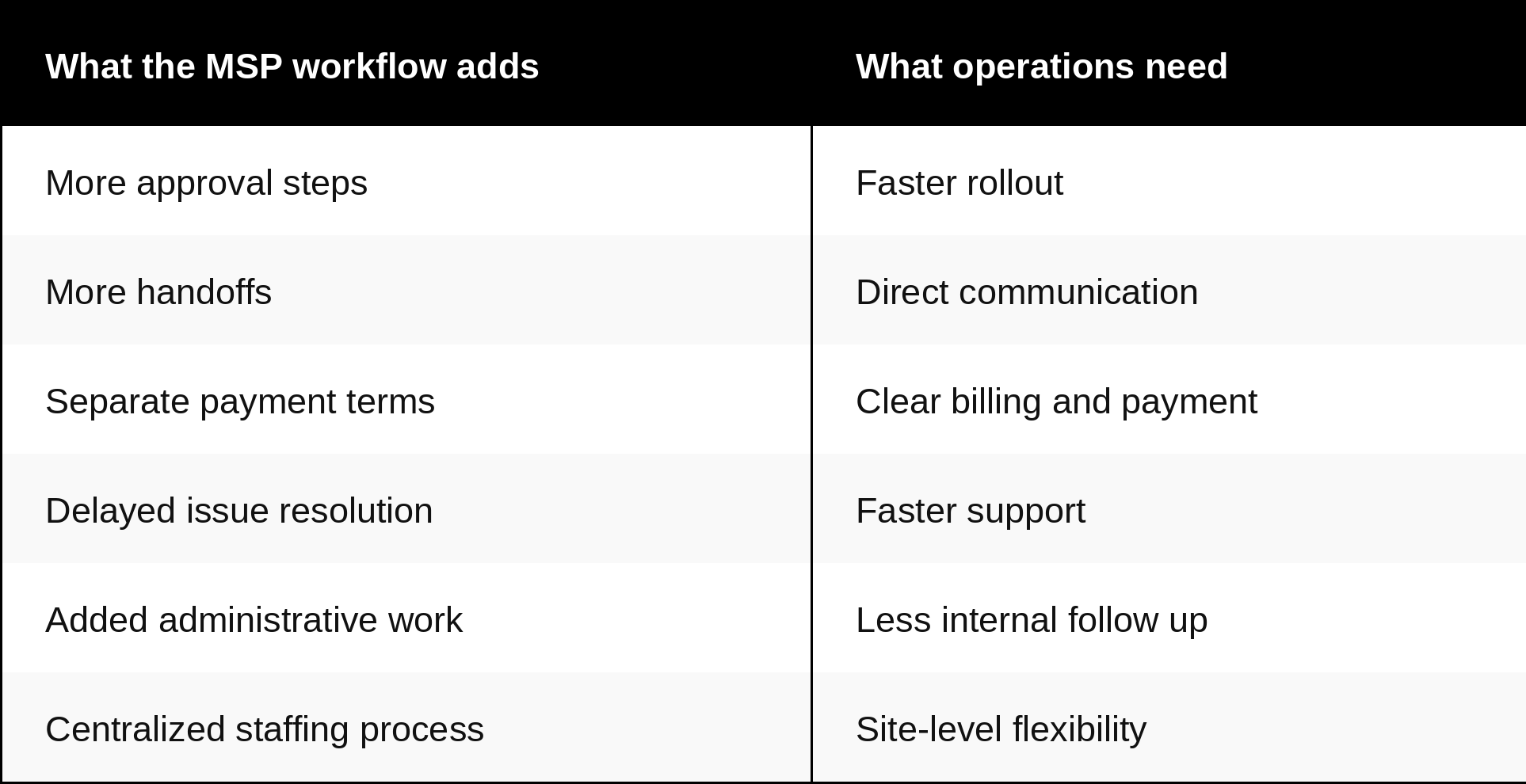
The MSP workflow does not help the site get operators faster, build a stronger labor pool, resolve issues sooner, or respond more effectively to changing demand.
It adds distance between the work and the platform built to support it.
MSPs are built around traditional staffing models and centralized supplier control. Veryable gives operations a more direct way to access flexible labor capacity.
That creates a structural conflict.
A flexible labor platform does not naturally fit a process designed to manage traditional staffing suppliers. When the MSP controls the workflow, that conflict can show up through slow approvals, delayed onboarding, inconsistent payment timing, and limited urgency around issue resolution.
The customer’s priority is getting work done. The MSP workflow adds processes without improving that outcome.
In one enterprise implementation, routing Veryable through the MSP created delayed vendor payment, added customer follow-up, administrative burden, operational friction, and relationship strain.
The MSP was not responsible for sourcing or onboarding Veryable, yet the customer still had to stay involved in resolving approval and payment issues.
After 13 months of friction, moving to a direct payment structure streamlined the relationship, addressed the major challenges created by the MSP model, and avoided an estimated $112,000 in service charge fees.
“Routing Veryable through the MSP added complexity and created both operational friction and relationship strain. Moving to direct payment streamlined the process and addressed these challenges.”
-Enterprise Customer (Fortune 150, Large Multi-Site Industrial Manufacturer)
Veryable should be set up as a direct vendor, not routed through an MSP.
A direct structure keeps operations connected to Veryable, gives the site a clear line of communication, and removes unnecessary handoffs from the relationship. It also establishes direct billing and payment terms so payment timing is not controlled by a separate MSP process.
Required documentation, insurance, compliance review, reporting, and approvals can still be maintained outside the MSP workflow. Those requirements do not need to sit inside a process that slows the operating relationship.
Running a traditional staffing company through an MSP may make sense. Veryable is a fundamentally different model, and routing it through the same structure works against the way it is designed to be used.
Veryable gives operations the ability to scale capacity up and down in real time as demand changes, without relying on planned staffing levels or a standing commitment. It is designed to drive cost out of operations, not add another layer of cost and administration.
Keeping Veryable direct preserves that flexibility while keeping the relationship, terms, and billing simple and transparent.
If your company is evaluating how to structure its relationship with Veryable, connect with our team to discuss a direct approach that avoids unnecessary MSP friction.



Create your free business profile and begin building your on-demand labor pool today.