Levering Up Your Specialists With On-Demand Labor: What It Looks Like In Practice
See how businesses use Veryable’s on-demand labor model to reallocate surrounding work and get more output from the specialists they already have.

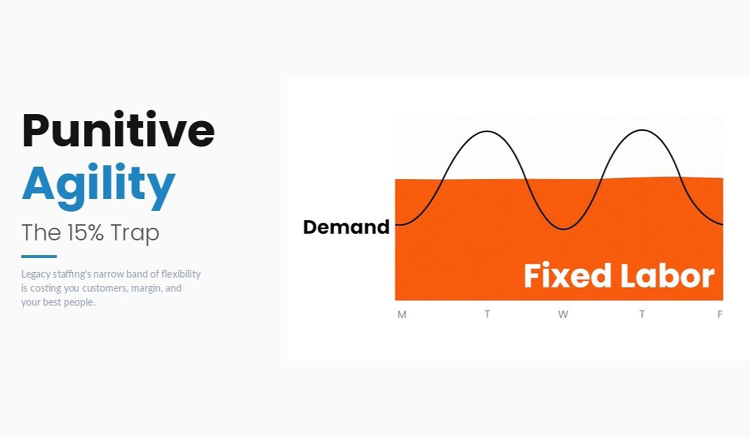
Most operations are built around a fixed workforce, but demand rarely behaves that way. The result is a constant cycle of overtime, cut hours, and reactive decisions that erode productivity, margins, and retention. This article breaks down why that cycle exists, why it caps flexibility at roughly 15%, and what it takes to build a workforce model that can actually keep up with real demand.
You already know the playbook. Demand spikes, you push overtime. People start burning out. Demand drops, you cut shifts – or worse, you lay people off. Your best operators start job hunting. And it almost always kicks in weeks after the problem already started costing you.
That cycle gives you about 15% of workforce flexibility. Let’s call it punitive agility – because every lever in the traditional playbook punishes someone.
Overtime forces extra hours on people who built their lives around a predictable schedule. Forced time off and layoffs strip income from people who chose full-time work for the reliability of a steady paycheck.
Neither direction is flexibility. It is volatility imposed on a workforce that specifically did not choose volatility. If employees wanted variable hours, they would already be on an app choosing extra shifts on their terms. They do not want more hours or fewer hours on your terms. They want consistency – and when you take that away, they start looking for someone who will give it to them.
If your workforce can only flex 15% and your demand swings 40%, you are not managing operations. You are managing a permanent crisis.
Here is the bigger problem: the industries that depend most on labor agility see demand swings of 30% to 65%. A 15% band does not just fall short. It locks you into a cycle of punitive agility – overtime burn, attrition, missed shipments, and bloated costs – that gets worse every quarter.
That is not a staffing challenge. It is permanent reactivity – a structural condition where the gap between what your workforce can flex and what your demand actually does guarantees waste in every direction, every week.
During upswings in demand, you can push overtime to about 10% above baseline headcount equivalent. During downcycles, you can pull back about 5% with forced time off, layoffs, and shift cuts. That gives you a total band of 15% – and every point of it is punitive to your workers.
The math is simple:
Upside flex = overtime hours ÷ base hours × (1 – productivity decay) – which caps around 10% in practice.
Downside flex = hours cut ÷ base hours × (1 – attrition triggered) – which caps around 5% before you start a turnover spiral that costs more than you saved.
BLS data from January 2026 shows manufacturing overtime averaging 2.9 hours on a 40.1-hour week – about 7% as a national average. But that average includes plants running no overtime at all. Facilities actively pushing overtime run 8 to 12 extra hours per employee per week.
The catch: not everyone can or will work those hours. Between absenteeism, skill gaps, and roles that cannot be doubled up, the real headcount-equivalent output increase tops out around 10%.
And that 10% has an expiration date. Overtime does not scale. It expires. Stanford economist John Pencavel found that productivity per hour drops sharply after 50 hours a week. Past 55, the extra hours produce almost nothing. Most damning: workers holding 60-hour weeks actually produced less total output than those working 40 – fatigue-driven errors ate more time than the extra hours created.
You are paying 1.5x per hour for people producing less per hour. Then the people start leaving. Burnout now puts 82% of employees at risk. Manufacturing turnover runs 28.6% annually, with production roles hitting 30% to 38%. Push overtime hard enough and you are speeding up the exit of the exact people you cannot replace.
Workers at 60 hours a week produce less total output than those at 40. Overtime does not scale. Past a threshold, it destroys capacity.
The downside is quieter but just as costly. When you force time off, cut hours, or lay people off, you are taking money out of the pockets of people who chose full-time work because they needed full-time income. They built budgets, childcare, commutes, and routines around a 40-hour paycheck.
JPMorgan Chase Institute research found that employer-driven changes in hours account for roughly half of all hourly worker earnings volatility. The typical hourly worker would take a 4 to 11% pay cut just to get schedule stability – meaning unpredictable hours hurt retention as much as an actual wage reduction.
Cut beyond 5% and take-home pay drops enough that your best operators start interviewing – as you’ve essentially cut your $30/hr specialist by $1.50/hr. You planned to save money for a few weeks. Instead, you spent the next two months backfilling at $4,700 per hire.
Five percent is the sustainable floor – the line below which you flex without triggering an attrition wave that costs more than you saved.
Punitive agility borrows from your workforce at 1.5x and pays it back in turnover at more than 3x the cost.
A narrow band is bad enough. But the real killer is timing. A staffing agency takes roughly 32 days to source, screen, and place a worker. Seasonal ramp-ups need 30 to 45 days of lead time. Even overtime decisions usually come after the problem has already hit the floor.
A 2025 industry study found 61% of manufacturing and logistics companies expect roles filled within 48 hours. The average agency takes weeks. That gap is where margin disappears.
Every day of delayed staffing during a spike means overtime premiums, missed shipments, and late penalties. Every day of overstaffing during a trough is waste sitting on the P&L. That timing delta is margin. And legacy staffing models hand it away by design.
This gap is not theoretical. Food and beverage manufacturers see demand swings of 30% to 40% – Core-Mark Distribution built an on-demand pool specifically to absorb the seasonal surges that were crushing their overtime budget. E-commerce fulfillment hits 50% to 65% around major shopping events. 3PL providers swing 40% to 55% as client portfolios shift volume on short notice.
Automotive suppliers run 25% to 35% – narrower, but just-in-time manufacturing means a single missed shipment can halt an assembly line. ADAC Automotive saved $1.6 million by shifting to on-demand labor instead of absorbing those swings with overtime and emergency agency calls. Building materials swing 40% to 50% on construction seasonality alone.
In every case, the 15% band covers less than half the actual demand variability. The rest gets absorbed by overtime premiums, missed deadlines, emergency agency placements, and attrition.
Reshoring is accelerating – supply chain companies in the U.S. are pulling production back from overseas as the true costs of globalization become impossible to ignore. Tariffs, IP risk, and the sheer fragility exposed by recent disruptions have made the case. But the deeper driver is agility. Nothing you import can flex.
When your supply comes from overseas, lead times run eight to sixteen weeks. No demand signal you receive today can change what you ordered last quarter. Your operation is not responding to real demand – it is running on a forecast made weeks ago, and that forecast is almost always wrong. The inflexibility is not a vendor problem. It is structural. It is built into the distance.
Reshoring is how companies escape that. Collapse the supply lead time from months to days, and you create the conditions for a truly demand-driven operation – one that can flex with actual orders instead of stale projections.
However, reshoring only solves half the agility equation. Once your supply can respond in days, your labor has to flex with it.
The labor market on the other side of reshoring is not the one companies left behind. The manufacturing sector has roughly 600,000 unfilled jobs right now. The National Association of Manufacturers projects up to 3.8 million manufacturing jobs will need to be filled by 2033, with 1.9 million at risk of going unfilled. The workforce is aging out faster than it is being replaced, and younger workers are not lining up to take the same deal their parents took – rigid schedules, mandatory overtime, and the constant threat of hour cuts when demand dips.
Reshore without solving the labor equation, and you have traded a supply constraint for a labor constraint.
Mike Kinder, CEO of Veryable, argued exactly this in the Journal of Supply Chain Management – advances in manufacturing technology favor a decentralized approach that prioritizes localization, customization, and reduced waste.
Here is what most operations leaders miss: the same punitive agility that traps companies is actively driving workers away from traditional employment and toward on-demand labor.
When you force overtime on someone who built their life around a 40-hour week, or cut their hours when demand drops, you are stripping away the one thing they valued most: control over their schedule. A growing subset of skilled operators has decided they would rather choose when to work more and when to work less – on their terms. On-demand platforms give them that. They bid for additional work when they want extra income. They scale back when they need time. The volatility is the same, but the control has shifted to the worker.
This is not a fringe trend. It is a structural shift. And it creates an opportunity that most companies have not recognized yet: the workers who left because they wanted control are now available to you through the same on-demand marketplace.
By building a deep labor pool of these operators, you can achieve a multiple of the flexibility you had before – 3x, 5x, even more – while protecting the fixed-schedule employees who chose full-time work for the stability it provides. The on-demand workers absorb the variability they opted into. Your core team gets the consistency they signed up for. Both sides win. The company gets agility that punitive levers could never deliver.
The same forces that created the labor shortage created the on-demand workforce. The companies that connect the two will own the next era of manufacturing.
The traditional answer for gaining agility across departments is cross-training – teach your people multiple functions so you can shuffle them around when demand shifts. But cross-training has a ceiling, and smaller manufacturers hit it first.
Stretch one person across too many roles and quality drops. Push cross-training too aggressively and you get burnout – the exact same punishment cycle you are trying to escape. Specialized tasks like forklift operation, CNC setup, and quality inspection carry certification requirements and meaningful learning curves; skills decay fast when used only 10% of the time.
Manufacturers already invest an average of 64 training hours per employee per year – the highest of any sector – at roughly $1,300 per head. That investment makes sense for core competencies. It makes far less sense for functions you need two days a month.
This is where a different model enters the picture. On-demand labor platforms work like a marketplace: businesses post work opportunities with specific skill requirements, schedules, and rates. Verified operators in the area – many of them experienced in manufacturing and logistics – bid on those opportunities and show up ready to work. There is no agency middleman, no long-term contract, and no minimum commitment. You pay for hours worked at a flat rate. The platform handles verification, ratings, and payment.
Think of it as building a bench of on-call specialists who already know your industry – without carrying them on your daily payroll.
This is where on-demand labor becomes a superpower for small and mid-sized manufacturers. 98% of U.S. manufacturers are small businesses. Three-quarters have fewer than 20 employees. These companies cannot afford to build multi-function agility through headcount or cross-training alone – they do not have enough people, enough budget, or enough hours in the day.
But through an on-demand marketplace, a 40-person shop can access forklift-certified operators, pick-and-pack crews, machine operators, and quality inspectors as needed – without training a single person into a role they will use twice a quarter.
You build agility across multiple functions without retaining it on your daily payroll. Your CNC operator stays sharp at what they do best. Your forklift needs get met by someone who drives a forklift every day, not someone who last touched one six weeks ago.
Replacing punitive agility does not require a restructure, a layoff, or a board presentation. It starts with decisions you are already making.
Before the tactics, here is how it works in practice. You post work opportunities on the Veryable marketplace – specifying the skill requirements, shift times, and pay rate. Verified operators in your area see the posting and bid on it. You review their profiles, ratings, and work history, then accept the bids you want. Operators show up, do the work, and get paid.
Over time, the operators who perform well become regulars – they know your facility, your standards, and your workflows. That’s Your Labor Pool. It deepens automatically as you use it, and it costs you nothing when you don’t.
Attrition is a constant. The default response is to backfill every vacancy with another FTE. Same fixed cost. Same rigidity.
The alternative: when an FTE leaves, do not automatically backfill. Simply post more on-demand labor, expanding your pool. You keep the same daily output. You gain flexibility.
Do this consistently over six to twelve months and 20%+ of your labor capacity becomes variable – without a single layoff.
The timeline: Month 1–2, you are replacing your first departures with on-demand labor and learning how the marketplace works. Month 3–6, your pool is deepening – regulars emerge, your posting rhythm stabilizes, and floor supervisors start trusting the model. Month 6–12, you have converted 15–25% of your labor capacity to variable without a single restructuring conversation.
The shift is gradual, organic, and driven entirely by attrition you were going to experience anyway.
When growth comes, absorb the new volume with on-demand labor instead of hiring ahead of confirmed demand. Post the work. Operators from the marketplace bid on it. If volume holds, those operators become part of Your Labor Pool, regulars who know your facility. If volume drops, you simply cut back posting.
This is how you scale without the inherent risk of scaling – you match labor to actual, realized demand instead of betting on a forecast.
Stop hiring for what might happen. Staff for what is happening. Let Your Labor Pool handle the rest.
The first two entry points address episodic workforce shifts: a departure, a growth event. Managing daily variance is different. It is the most natural and universal way to build Your Labor Pool, because every operation already generates the variability that drives it.
You do not need a vacant FTE or a new contract to start. You need the variability you already have.
Look at any given week in your operation. A large order lands Monday afternoon that was not in the plan. A piece of equipment goes down Tuesday morning, pulling your certified operators off the line and opening a gap on packaging. A supplier delivers materials three days late, then all at once on Friday, creating a crunch your current crew cannot absorb at straight time. Someone calls out on the second shift. A customer pulls a delivery date forward by four days. A quality hold on one line forces a rebalance across the floor.
These are not exceptional events. They are the normal texture of manufacturing and distribution operations: daily and shift-by-shift, compounding across weeks and months into the patterns that define your demand curve.
Each one is a moment where you currently scramble: mandatory overtime on short notice, workers borrowed from another department, a staffing agency call that will not produce results for weeks. Each scramble costs more than it should and solves less than you need.
On-demand labor solves each of those moments the same way: post the work, operators bid on it, you select the ones you want, and they show up. The cost is straight time. No premium. No agency lag. No one on your core team receives an unwanted overtime notice.
Here is what most leaders miss about this entry point: you do not need to have a pool to start building one. Every time you post for a daily need, such as a shift gap, an order spike, an equipment-down scramble, and you bring in a mix of operators. Some are already familiar with your facility. Some are seeing it for the first time. The ones who perform well will bid on your next posting, because they already know your layout, your standards, and your supervisors.
Post again and they come back. They become regulars. They become Your Labor Pool.
This happens without a restructuring conversation, without a hiring event, without a deliberate pool-building campaign. The daily use of the marketplace is the pool-building campaign. And it works even when your headcount is stable, your attrition is low, and your growth is flat.
A steady-state operation with consistent FTE headcount still has shift-by-shift variability, weekly order patterns, and monthly demand curves that shift around scheduling windows and customer requirements. Every time you use on-demand labor to handle those moments instead of forcing overtime or pulling from another department, you expose new operators to your facility and give returning operators another reason to come back. The pool deepens. The bench of regulars grows.
None of it required a layoff, a headcount plan, or a board presentation.
Every order spike, every equipment breakdown, every supply interruption is a pool-building event, if you are using the marketplace to solve it instead of the overtime sheet.
The operators who learned your facility covering a Tuesday order spike are the same operators who show up when your volume runs 40% above baseline in Q4. The pool you built through daily use becomes the pool that handles your seasonal swings.
The operators who know your line speeds, your quality standards, and your supervisors’ names do not need two weeks to ramp up when peak season hits. They were already there for the small moments. They are ready for the large ones.
This is the structural advantage that daily agility creates. Your Labor Pool has been road-tested on the real variability of your operation: not just ready in theory, but proven across dozens of small moments before the seasonal surge or growth event arrives.
Daily ebbs and flows. Weekly order patterns. Monthly demand curves. And when the big swing comes, your pool does not need to be built. It already was.
At Veryable, we recommend building a labor pool at 3x your daily agility need. The math behind it is simple.
On-demand operators typically work 3 to 4 days per week, roughly 70% availability. If you build a 1x pool of 10 operators for a 10-person need, you average 7 available on any given day. You are running 3 short as a baseline.
At 3x, your pool of 30 yields an expected 21 available operators on any given day, more than double your need, with a 99.99% probability of filling every slot. That is the difference between hoping your people show up and knowing your coverage is locked in.
That pool gives you a deep bench of trained operators who bid on your posted work regularly. On a normal day, you pull from the pool to cover your daily flex. On a heavier day, you pull deeper. Beyond the pool sits the broader Veryable marketplace, operators who can accept work on short notice, providing depth no internal bench or agency can match.
During downcycles, you simply do not post work. That on-demand layer becomes immediate downside flex, 3x+ the downcycle agility of legacy forced time off and layoffs. No severance. No morale hit. You just stop posting, and the cost disappears.
Stack that on top of your existing FTE flex. Combined with an on-demand pool, you are operating in a ~45% daily agility band on a typical day. When you pull deeper from the pool, that widens further. All at loaded FTE-equivalent rates. No overtime premium. No agency delay.
The question is not whether you can handle the swing. It is whether you are still paying a premium to handle it badly with overtime, temps, and waste.
Now the question is not about math or mechanics. It is about people. Specifically: what happens to your full-time workforce when you stop using them as the flex layer?
The answer is the part most leaders miss. On-demand labor does not just fix the P&L. It fixes the experience for the people you cannot afford to lose.
Here is the part that changes the framing entirely. The shift to on-demand labor is not something that might happen. It already has. Millions of workers have already moved to platform-based, flexible work models. They are not coming back to rigid full-time schedules. They chose control over their time, and they are not going to unchoose it.
This matters beyond recruiting. The Randstad 2025 Workmonitor found that 41% of workers would accept a lower salary in exchange for better work-life balance. That is nearly half the labor market telling you that flexibility is worth more than dollars. The operations that understand this keep the workers they have. The ones that do not keep losing them to the 15% trap cycle: overwork the people you need, watch them leave, spend months replacing them, repeat.
The insight that unlocks everything: volatility should not sit on people who did not choose it. Your full-time employees chose stability. They built their lives around predictable hours and predictable income. When you force overtime or cut their hours, you are imposing volatility on people who specifically opted out of it.
On-demand workers made the opposite choice. They opted into variable work because they want control over which shifts they take, which facilities they work at, and how many hours they work in a given week.
Volatility should sit on the layer that chose it. Your full-time team chose stability. On-demand workers chose flexibility. Stop punishing the wrong group.
When you stop using your core team as the flex layer, something changes on the floor. Overtime drops. Burnout drops. The people who stayed because they believed in the work stop looking for exits.
That is not an engagement problem. That is a structural problem created by using full-time workers to absorb demand volatility they never signed up for.
The National Association of Manufacturers found that 58% of member companies are now implementing flexible work options in production environments. That number was negligible five years ago. The shift is happening because the math is undeniable: companies that protect their core workforce from demand volatility retain better, produce more consistently, and spend less on the churn cycle of recruiting, hiring, training, and losing people.
Veryable customers can eliminate 95% of mandatory overtime. Not because they cut production. Because they stop forcing their full-time team to absorb every demand spike. The overtime hours move to on-demand operators who chose those hours. The core team gets what they wanted all along: a stable, predictable schedule.
Retention improves. Quality improves. The P&L improves. All from the same insight: flexibility is a reward for the people who want it. Overtime is a penalty for the people who do not.
Flexibility is a reward for the people who want it. Overtime is a penalty for the people who do not. The system should know the difference.
The real unlock is not cost savings, although the savings are significant. The real unlock is what happens to your operation when your best people stop leaving.
When your most experienced operators are not burned out, not resentful, and not scanning job boards during lunch, the compounding effects are enormous. Fewer errors. Faster changeovers. Better training of new hires and on-demand operators. Institutional knowledge that stays in the building instead of walking out the door.
NIST MEP research found that 90% of small manufacturers hoard labor during downturns because the cost of losing and replacing skilled workers is too high. That is a rational response to a broken system. But labor hoarding is not a strategy. It is an admission that the system has no other answer.
On-demand labor gives you a different answer: keep your skilled workers fully utilized on their highest-value tasks. Let the marketplace handle the variable, general-purpose work. Your specialists become force multipliers instead of being diluted across tasks that waste their expertise.
Consider the scale of the problem. 98% of U.S. manufacturers are small businesses. 75% have fewer than 20 employees. For these companies, losing even one skilled worker can cripple a production line. The 15% trap is not an abstraction for them. It is the reason they run overtime until people quit, then spend months trying to replace them.
On-demand labor breaks that cycle by ensuring the demand volatility never reaches the core team in the first place.
When demand swings upward, your floor supervisor posts work on Veryable that afternoon for the next morning. Operators from the labor pool bid on the work, people who have worked your facility before, know your standards, and can produce without a week of onboarding. Your full-time team shows up to their normal shift, doing the work they were hired to do. No mandatory overtime notice. No morale hit.
When demand softens, you simply post less. Your on-demand layer contracts automatically. If an FTE leaves during the slowdown, you do not backfill. The fixed cost line falls on its own. No difficult conversations about headcount reductions. No severance.
The people who chose stability keep their stability. The workforce structure does the work that management decisions used to do: badly, expensively, and too late.
Over time, your best on-demand operators become regulars, people who know your floor as well as any FTE. The line between “core team” and “labor pool” is not about how often someone works for you. It is about which employment structure serves each person best.
Your full-time team gets the predictability they chose. Your on-demand operators get the control they chose. You get a workforce that is structurally capable of handling whatever demand does next, without punishing anyone in either direction.
An on-demand workforce structure closes the gap between operational need and labor reality that legacy workforce management spent decades making wider.
When on-demand labor costs the same as a loaded FTE but never triggers overtime, the savings compound two ways. You kill the 1.5x multiplier on surge labor entirely, and you right-size permanent headcount to true baseline demand – no more paying for idle capacity during troughs.
Run the scenario: 100-FTE baseline, demand swinging between 70 and 130 over eight weeks. Legacy model: staff at 100, pay OT at 1.5x during peaks, absorb idle cost in valleys. On-demand model: core team of 80, flex the rest at 1x rates. Same output. Significantly lower total labor cost. Zero burnout premium. Zero idle waste.
On-demand labor compresses planning cadence from monthly or quarterly to daily. Ops leaders start making workforce decisions the way they already make production decisions: based on what the next 24 to 72 hours actually look like.
It changes who decides (floor-level ops, not just HR), how often (daily, not monthly), and what data drives it (real-time demand signals, not lagging headcount reports). Just-in-time workforce management becomes possible.
The 15% trap is not going to open on its own. Every force acting on manufacturing labor is compressive: reshoring acceleration, a structural labor shortage, rising worker expectations, and demand volatility that is only getting wider.
The companies that keep forcing agility through overtime, layoffs, and emergency agency calls will keep losing the race. The ones that build a variable labor layer, protect their core workforce, and match volatility to the people who chose it will operate in a fundamentally different band.
This is not a theory. It is already happening on thousands of shop floors.
The question is whether you build the system now, while you still have the workforce to protect, or wait until the trap closes further and the options narrow to the ones that were already failing.
The 15% band is not a staffing challenge. It is a structural condition. And structural conditions require structural solutions.
Ready to see the math for your operation? Start the conversation today



Create your free business profile and begin building your on-demand labor pool today.