Levering Up Your Specialists With On-Demand Labor: What It Looks Like In Practice
See how businesses use Veryable’s on-demand labor model to reallocate surrounding work and get more output from the specialists they already have.

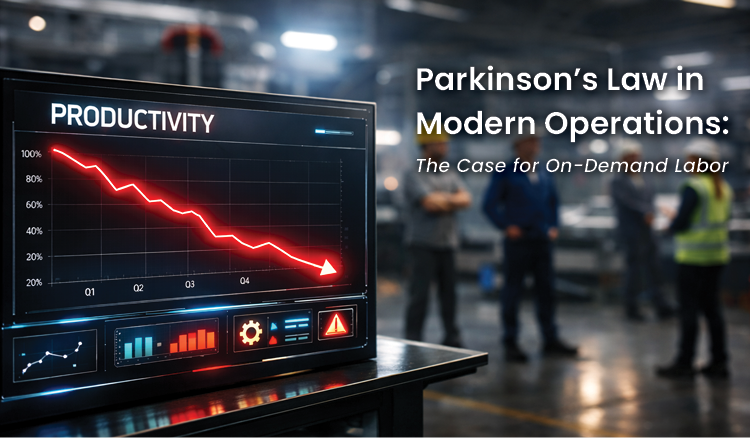
In 1955, C. Northcote Parkinson opened an essay in The Economist with a line he intended as a joke: "Work expands so as to fill the time available for its completion."
He described an elderly woman who spends an entire day sending a postcard. Finding the card. Locating her glasses. Composing the message. Debating whether to bring an umbrella for the walk to the mailbox. A busy person handles the same task in three minutes. The woman, with nothing but time, converts a three-minute errand into a full day's work and feels appropriately tired at the end of it.
The joke landed. Researchers spent the next seventy years proving it was also a diagnosis. And if you run an operation with fixed headcount and variable demand, the diagnosis is yours.
Start with what we can prove in a lab. In 1999, Brannon, Hershberger, and Brock published a study in the Psychonomic Bulletin & Review. Participants judged sets of photos against a subjective criterion. Before the third set, they learned the fourth had been canceled. Idle time was coming. They immediately slowed down. Replicated twice. Same result. The only variable was the awareness that nothing was waiting on the other side.
The pacing shift was not a decision. It was automatic. The participants did not know they had slowed down. Which means you cannot coach this out of someone. And your time study will not catch it, because the time study measures the method, not the reason the method is taking longer.
Now put that on a production floor.
Your engineered standard says 4.2 minutes. Your operator runs 5.1. Your LMS flags it. Your supervisor coaches on method. But the method is fine. The operator runs a 5.1 because nothing is waiting at the end of a 4.2. The brain did exactly what Brannon showed it will do. And everyone involved, the operator, the supervisor, the industrial engineer reviewing the data, is looking at the wrong thing.
That is the first layer. Here is the second.
Frederick Winslow Taylor called it "soldiering" in 1911: operators collectively restricting output because they understood that demonstrating full capacity in a slow period would mean fewer hours or fewer heads. The Hawthorne Studies confirmed it at scale. Informal groups established unwritten pace norms that overrode management directives and economic incentives entirely.
Soldiering is conscious. It is strategic. It is rational self-preservation, and honestly, it is hard to blame.
Work-stretching is something else. Brodsky and Amabile documented it in a 2018 study in the Journal of Applied Psychology. 78.1% of workers reported experiencing involuntary idle time. When operators anticipated idle time after a task, they unconsciously decelerated to avoid appearing idle. The estimated annual cost to U.S. employers: $100 billion. Quality did not improve. Workers simply took longer to make the same mistakes.
Here is why this distinction matters to you: a strong culture can fix soldiering. Gain-sharing, open-book management, honest conversations about demand. These reduce the rational incentive to hide capacity. Good. But work-stretching operates below conscious awareness. You cannot culture your way out of neurology. Even in a high-trust environment, if idle time lies ahead, the brain recalibrates. Your best operators, your most loyal people, the ones who genuinely want to perform, are doing it too. They just do not know it.
Your LMS measures one operator against a benchmark. It does not measure the informal pace agreement among the six operators on the line, the one that recalibrates every time demand softens. And it certainly does not measure the unconscious deceleration that no one on the line knows is happening.
They were not hiding their capacity because they were dishonest. They were hiding it because they were paying attention. And some of them were not hiding it at all. They were just slower, and they did not know why.
Here is where it gets uncomfortable for anyone who has invested in lean.
Engineered standards capture a snapshot. When demand and product mix shift, the standard becomes a historical document. The operators know it before the industrial engineers do.
Heijunka level-loads production, but when volume drops 30% for six weeks, it distributes idle labor more evenly. You have not solved the problem. You have balanced it.
Shojinka is the right concept: flex the number of operators to match demand. But it requires you to reduce headcount on the line when volume drops. Rotate the same people through additional tasks and you have given them variety while they work slowly.
Coach one operator to 95%. If the line norm is 82%, that 95% will not last the month.
And here is the part that should bother the best operators in the room: pull systems and visual management solve the information problem. The operator sees demand. Kanban signals what is needed. Andon makes problems visible. But seeing demand is not the same as having demand. When volume drops and headcount stays fixed, every operator on the line knows there is more time available than the work requires. The visual management system faithfully displays this reality. The brain does what the Brannon study showed it will do.
No amount of visual management overrides neurology. Not at Toyota. Not at your plant. Not anywhere.
The problem is not that your workforce does not know the standard. It is that the standard and the actual workload are not in the same conversation.
Research on habit formation shows it takes roughly 66 days for a behavior to become automatic. Six to eight weeks of reduced pace is not a temporary adjustment. It is a new neurological default. And when challenge drops below skill level, the result is not rest. It is disengagement. Too little demand degrades performance as reliably as too much.
A slow month does not just cost you a slow month. It costs you the month, plus the weeks it takes to undo what the month taught. And with manufacturing turnover running near 26%, new operators are learning the slow pace from day one. They have no memory of the fast one.
In 2024, the New York Fed published "The Mysterious Slowdown in U.S. Manufacturing Productivity." From 1987 to 2007, labor productivity grew 3.4% annually. From 2010 to 2022: negative 0.5%. R&D investment increased the entire time. Firms spent more and produced less.
There are multiple contributing factors: measurement changes in how manufacturing GDP is calculated, composition effects from offshoring high-productivity segments, automation disruptions during technology adoption curves. But the post-2008 recovery was also defined by demand volatility, cautious hiring, and workforces alternately underutilized and overextended, exactly the conditions that produce work-stretching and pace decay at scale. This is not the entire explanation. It is the part of the explanation that is within your control.
BLS data from 2024: productivity declined in 52 of 86 manufacturing industries. Fed data shows capacity utilization at 75.6%, nearly three points below the long-run average. That is not just idle machines. It is labor deployed against a three-quarters workload, encoding that pace as the new baseline.
The core insight is not that your workforce is slow. It is that the ratio of demand to available hours is a structural variable that drives pace, and almost no one measures it, manages it, or puts it on the fishbone diagram.
There are multiple ways to address this ratio. Cross-training and redeployment to other value streams can absorb some variability. Maintenance and improvement work during low-demand periods can keep challenge levels high. Demand shaping and production smoothing can reduce the amplitude of swings.
But every operation has a band of demand variability that exceeds what those tools can absorb. When volume drops below what your fixed headcount can handle through redeployment and improvement work, Parkinson's Law takes over. That is the gap on-demand labor is built to close.
Match labor capacity to actual demand and there is no slack time to fill. Volume rises, you add operators. Volume drops, you release them. Your core team never sits in the prolonged low-challenge state that triggers unconscious pace decay. This is what shojinka was designed to accomplish. On-demand labor achieves it without purpose-built U-cells or full cross-training programs.
The objection is always ramp time and quality. But consider what you are comparing it against: a permanent workforce that has spent the last six weeks training itself to operate at 82% of standard. The ramp time you worry about with on-demand operators is shorter than the ramp back up from embedded pace decay. And the on-demand operator has no informal pace agreement to honor. They show up, they work, they leave.
Scentsational Soaps & Candles, a Veryable customer, reported a 28% productivity increase and a 15% reduction in labor costs as a percentage of sales after adopting on-demand labor. Goodwill Houston saw a 14% productivity boost and a $2.3 million revenue increase by using on-demand operators to match capacity to fluctuating donation volumes.
You do not need to motivate your workforce to be productive. You need to stop putting them in an environment that trains them not to be.
Parkinson wrote his law as satire. Your labor model runs it as policy. The only difference between the elderly woman with the postcard and your production floor is that she was working with her own time.
You are paying for yours.
If you're ready to change that, get in touch.



Create your free business profile and begin building your on-demand labor pool today.