Levering Up Your Specialists With On-Demand Labor: What It Looks Like In Practice
See how businesses use Veryable’s on-demand labor model to reallocate surrounding work and get more output from the specialists they already have.


This article is written for the leaders of Manufacturing Extension Programs (MEPs), workforce boards, and regional economic development organizations responsible for deploying public funding and defending measurable impact.
Across the country, program leaders are being asked a question that is becoming increasingly difficult to avoid: What actually changed as a result of this work?
Not how much activity occurred, how much funding was deployed, or how compelling the narrative sounded. The focus is shifting to what measurably improved for the manufacturers, workers, and communities these programs exist to support.
As federal spending comes under closer review, state and local agencies have followed with their own accountability efforts. This is not a political shift; it is an operational one.
Public funding and private operations have long functioned under different sets of incentives. In many publicly funded environments, success is often measured by the full deployment of a budget to protect future cycles. In private industry, success is measured by whether an initiative actually moved the needle.
Over time, this difference has shaped behavior. Activity, such as meetings, workshops, and placements, became a stand-in for progress. But while programs stayed busy and reports were delivered, operational outcomes were not always clearly defined. The result is an ecosystem of dedicated teams with strong missions that often struggle to move from effort to outcome.
In industry, leaders ask a simple but difficult question: If the businesses we serve were asked what actually changed because of our work, what would they say? Not what was intended. Not what was reported. But what they experienced inside their operation. That question shifts the focus from protected funding to sharpened accountability.
Two years ago, a state-run program celebrated the creation of 20 jobs over a four-year period. During that same time, the organization itself grew to more than 20 employees. The program cost more to operate than the economic impact it produced, and it failed to change manufacturing capacity or execution inside the facilities it was meant to support.
That same year, one of our initiatives delivered the equivalent of 200+ full-time jobs in labor hours in one quarter. This was achieved at zero taxpayer cost because the work was tied directly to operational demand. Stories do not replace outcomes. Headcount alone does not define progress. Visibility does not equal value.
That contrast isn’t theoretical. It’s measurable.
Outcome-driven programs tend to show up in a few consistent ways. While contexts differ, the common thread is that success is measured by what changed operationally, not by activity or visibility.
Below are examples of how this approach shows up across manufacturing, logistics, workforce development, and economic development initiatives.
Click each category to see detailed examples, or here for the full set.
Each example represents a measurable operational outcome. Not a pilot. Not a press release. Not a projection.
When local leadership creates the conditions for participation, regional labor activation does not take years; it begins compounding quickly.
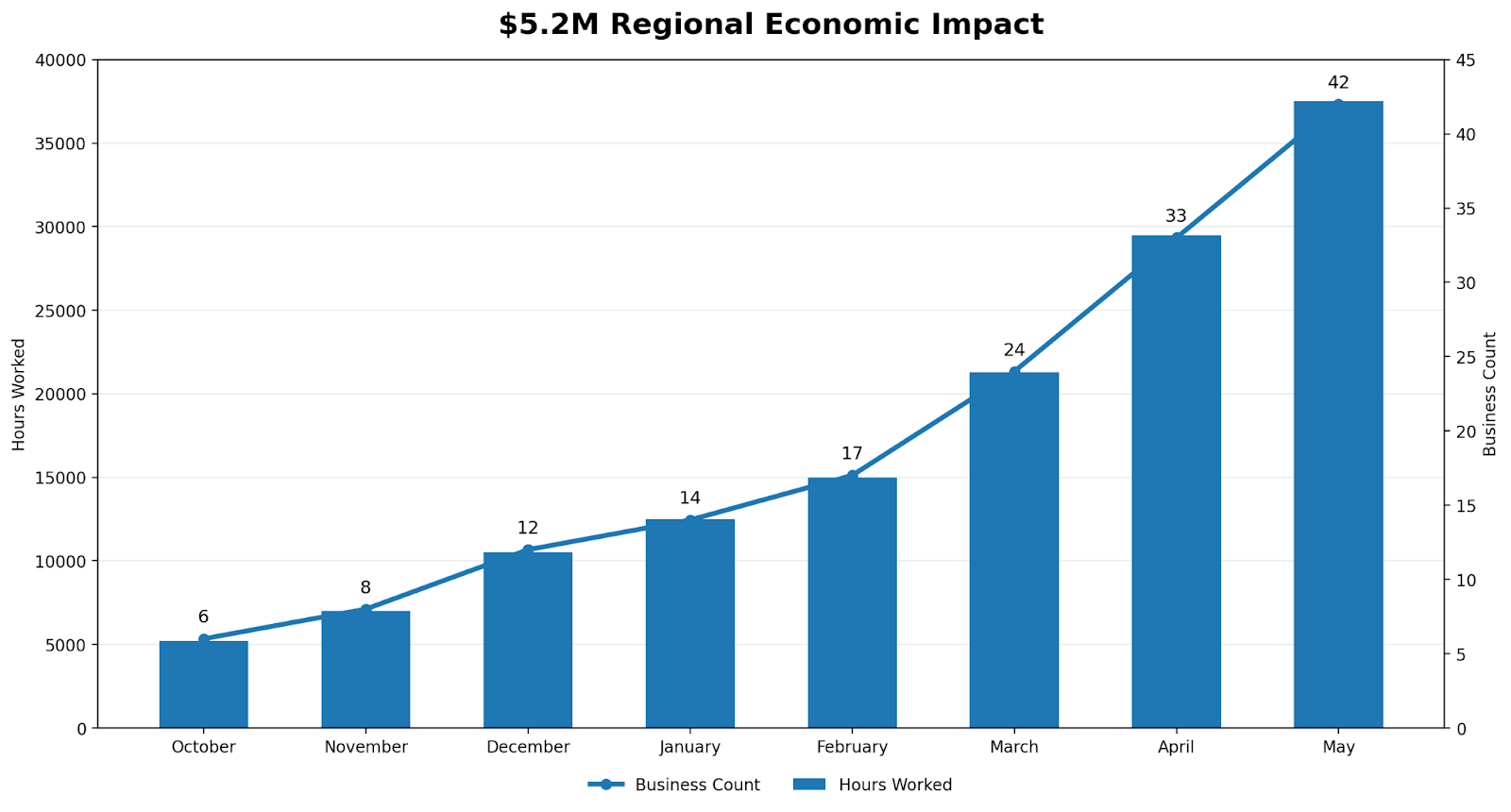
Eight-month regional labor pool activation following engagement by local manufacturers.
As manufacturers increase utilization and labor hours scale, the impact extends beyond individual facilities. Higher production levels support steadier employment, more consistent income, and increased local spending across the communities where that work occurs.
This creates a win-win-win:
These dynamics directly support the outcomes public funders are accountable for: employment stability, per-capita income growth, and regional economic resilience.
At Veryable, activity alone doesn’t justify a partnership; outcomes do. We believe that if our platform isn’t delivering measurable operational results, it isn't adding value.
When programs shift their focus to this, they move from "busy work" to results like:
This shift represents a massive opportunity. Those who can clearly explain what changed, how quickly it changed, and why it mattered are not defending their relevance; they are reinforcing it. Conversely, programs that cannot point to these types of operational results will face increasingly difficult questions about their impact and ultimate value.
If the businesses you serve were asked what impact you’ve made on their operation, what would they say? Veryable exists to help make that answer measurable and defensible. Not with anecdotes, but with results.



Create your free business profile and begin building your on-demand labor pool today.