Beyond The Baseline: Protecting Q4 Throughput When Volume Strays From the Forecast
Seasonal hires and temp agencies cover Q4 baseline headcount, not daily volume swings. Learn how on-demand labor protects Dock-to-Stock, UPH, and OTIF.

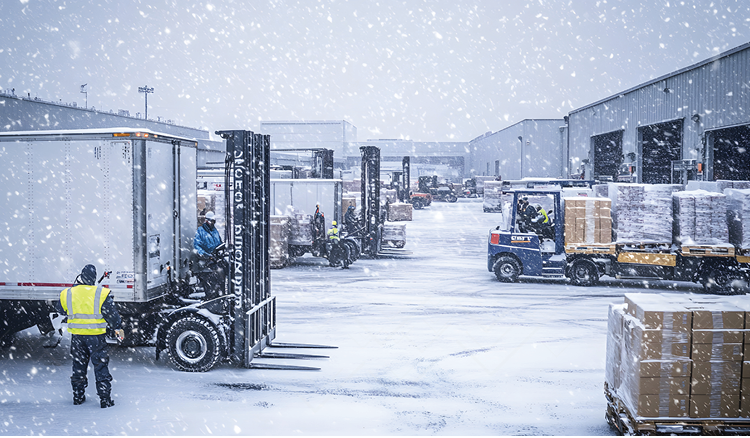
Winter storms often strike with little warning, forcing industrial operations into a standstill. Power outages, facility closures, and unsafe travel conditions can quickly reduce attendance and halt production or fulfillment.
While the initial shutdown is disruptive, the real complexity begins the moment operations restart.
As facilities resume operations, orders delayed by the storm flood back into the system simultaneously. Transportation resumes unevenly, yet customer delivery commitments remain fixed.
This creates a critical recovery window: the decisions made in the first 48 to 72 hours determine whether an operation stabilizes or suffers from service disruptions that persist for weeks.
Veryable’s on-demand marketplace acts as a pressure-relief valve, allowing operations to inject capacity at specific bottlenecks, like the dock or the picking line, the moment the facility reopens.
Recovery rarely follows a linear path. Inbound freight returns in unpredictable waves as routes reopen and delayed loads are released simultaneously. Inside the facility, material is often out of position, staging areas reach capacity, and supervisors are pulled away from restart coordination to address manual bottlenecks on the floor.
The traditional response is excessive overtime. Labor cost quickly escalates to 1.5X or 2X normal rates, yet output rarely increases at the same pace. As fatigue sets in, productivity declines and safety risk rises.
Allowing backlog to sit avoids overtime, but it introduces a different set of problems. Missed delivery commitments trigger customer escalations, costly expedited freight, and downstream friction that often lasts far longer than the storm itself.
At this point, operations are forced to choose between cost escalation and service degradation. On-demand labor provides a third option.
Veryable’s on-demand marketplace empowers companies to maintain operational continuity by deploying incremental labor through individual, shift-based postings.
Unlike traditional staffing, Veryable enables businesses to post individual shifts, known as Ops, directly through a web-based portal with 24/7 access. These opportunities are immediately visible to a local pool of independent contractors via the Veryable app, where they can review your specific requirements and place bids in real-time.
And because the platform operates on a bidding system, it creates a self-selecting workforce. Instead of being assigned a worker, you choose from a list of Operators who have already reviewed your shift details and proactively confirmed they are ready, willing, and able to perform the work.
1. Accelerating Cleanup and Facility Recovery
Once power is restored, facilities often require immediate cleanup, restaging, and safety inspections. On-demand operators can be deployed specifically for pallet restaging, damaged product inspection, and general recovery tasks. This allows restoration to begin the moment the doors open, ensuring your core team remains focused on restart coordination and outbound planning.
2. Eliminating Backlogs Without Excessive Overtime
Storm-related shutdowns create immediate backlogs, often leading to mandatory overtime. On-demand labor provides the additional capacity needed in constrained areas (such as picking, packing, and material movement) to clear the backlog quickly. This preserves the health of your core team while shortening the total recovery timeline.
3. Bridging Attendance Gaps During Transportation Disruptions
Even after a facility reopens, attendance often remains uneven due to unsafe road conditions or childcare disruptions. On-demand operators provide essential coverage during this transition, preventing recovery delays from compounding and relieving pressure on full-time employees unable to return immediately.
4. Expanding Operating Windows
In many scenarios, equipment is ready but standard shift hours limit how quickly volume can be processed. On-demand operators are frequently used to support temporary evening, overnight, or weekend shifts, increasing daily output without permanently altering schedules.
During the 2021 Texas winter storm, a regional beverage distributor serving more than 100 retail locations lost power and was forced offline for nearly a full week. When the facility reopened, demand spiked as orders placed during the outage accumulated. Meanwhile, attendance remained inconsistent as many employees were still without power or reliable transportation.
The operation utilized Veryable’s marketplace as soon as power was restored. Additional operators supported restocking, order picking, and dock activity, allowing supervisors to focus on sequencing outbound orders rather than manual recovery work. Labor was adjusted daily based on backlog; as flow stabilized, postings were reduced. Outbound performance was restored quickly, minimizing disruption to downstream stores while competitors were still navigating service delays.
On-demand labor is uniquely suited to rapid deployment during recovery.
Here's how it works:
1. Create your Veryable business profile
Setup takes only a few minutes and immediately allows your team to post work and review bids.
2. Start with straightforward recovery work
Initial postings should focus on simple, repetitive tasks that require minimal onboarding. This builds immediate momentum and gives supervisors visibility into operator skills, reliability, and pace.
3. Rate operators and build your labor pool
After each op, rate operators on performance. Those rated 4 or 5 stars will be automatically added to your "Labor Pool", allowing you to quickly invite them back when additional coverage is needed.
4. Expand coverage as recovery progresses
As backlog builds or volume returns unevenly, additional shifts can be posted to scale capacity without relying on overtime.
5. Reduce postings as operations stabilize
Once flow and attendance return to normal, postings can be stopped entirely without any long-term commitment.
On-demand labor is easy to activate during unplanned events like winter storm shutdowns, which makes it an effective recovery tool. However, recovery is only one of many ways companies use it.
For thousands of manufacturers and distributors, on-demand labor is used to manage variability that fixed labor models cannot absorb. Last minute changes in demand, tariff-driven volatility, seasonal surges, returns spikes, and short-term projects all create labor needs that change faster than traditional models can adapt.
As companies continue using the platform, a familiar labor pool develops. This creates a more resilient workforce that eliminates reliance on overtime and overstaffing, allowing labor cost to align more closely with actual operating conditions and support consistent execution under ongoing variability.
To learn more about how you can get started today with on-demand labor, check out our guide or get in touch.


Create your free business profile and begin building your on-demand labor pool today.